Moving Beyond Reactive Maintenance
Traditional waste compactor maintenance follows a simple pattern: something breaks, you call the technician, they fix it. This reactive approach leads to unexpected downtime, emergency callout fees, and frustrated building occupants dealing with overflowing bins while repairs are underway.
Predictive maintenance flips this model entirely. By using real-time sensor data from IoT-connected waste compactors, facility managers can now anticipate failures before they happen, schedule repairs during quiet periods, and extend equipment lifespan significantly. For Singapore properties managing multiple waste handling assets, this shift represents substantial cost savings and operational improvement.
How Remote Diagnostics Work in Waste Equipment
Sensor Data Collection
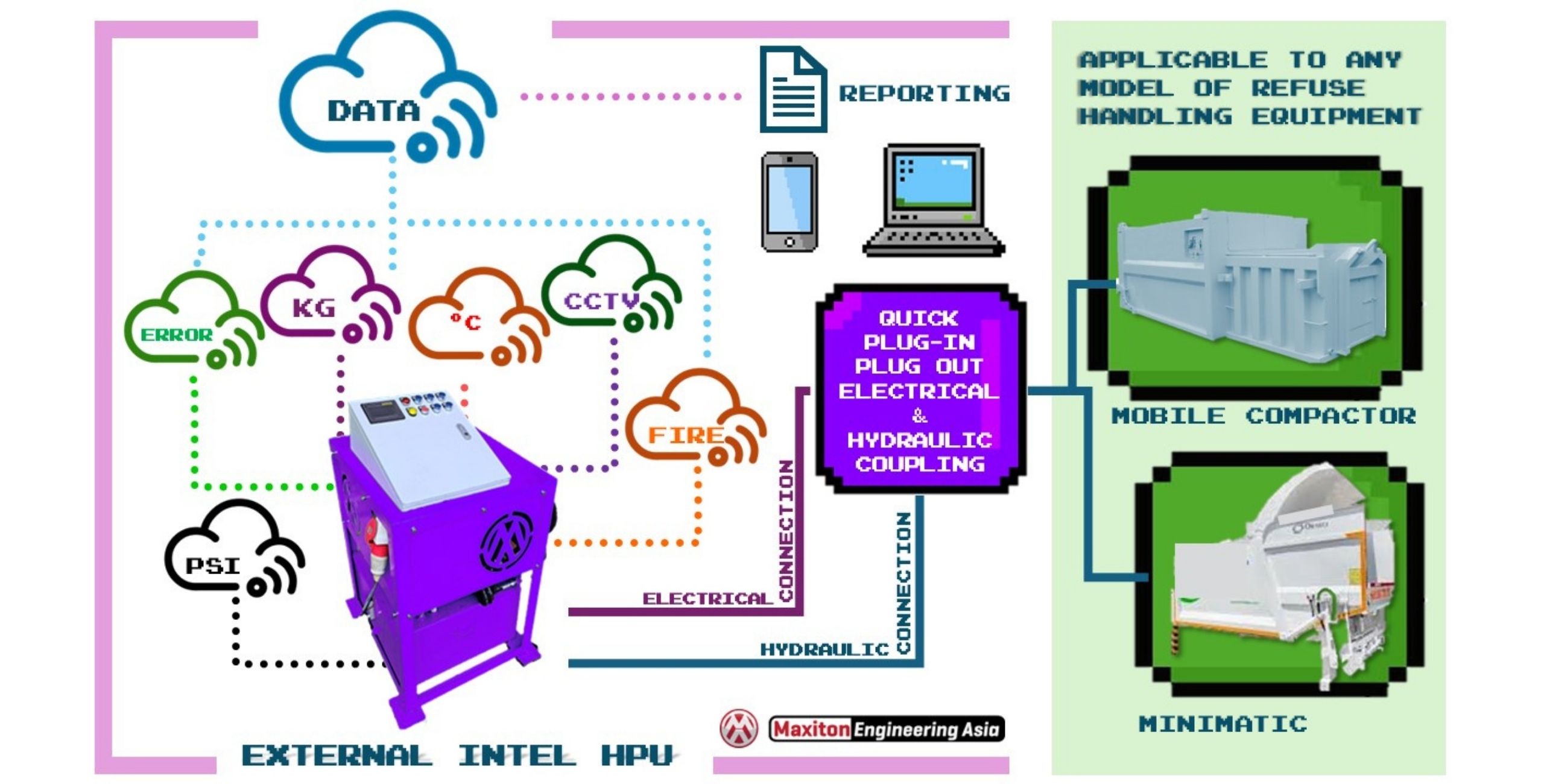
Modern smart waste compactors are equipped with multiple sensor types that continuously collect operational data:
- Hydraulic pressure transducers — monitor system pressure during each compaction cycle
- Temperature sensors — track hydraulic oil temperature and motor winding heat
- Vibration sensors — detect abnormal vibrations in the HPU motor, pump, and ram assembly
- Current sensors — measure electrical draw patterns on the motor
- Cycle counters — record total compaction cycles and cycle duration
- Fill level sensors — ultrasonic or load cell measurements of container fullness
This data is transmitted via MQTT or cellular connections to a cloud platform where it can be analysed in real time and over historical periods.
Pattern Recognition and Anomaly Detection
The real value of remote diagnostics lies in pattern analysis. A healthy compactor has consistent pressure curves, stable temperatures, and predictable cycle times. When these patterns shift — even slightly — it often indicates developing issues weeks before an actual failure occurs.
For example, gradually increasing cycle times combined with slightly elevated hydraulic pressure may indicate wear in the pump or cylinder seals. A technician dispatched based on this early warning can replace seals during a scheduled maintenance window rather than responding to a sudden breakdown.
Common Failure Modes Detected Early
Hydraulic System Degradation
Hydraulic systems account for the majority of compactor maintenance issues. Remote diagnostics can detect:
- Seal wear — identified by slow pressure decay or increasing cycle times
- Oil contamination — shown by erratic pressure readings or elevated temperatures
- Pump cavitation — detected through unusual vibration signatures and pressure fluctuations
- Valve failures — indicated by incorrect pressure sequencing or slow response
Early detection of these issues prevents catastrophic failures that could damage the cylinder, contaminate the entire hydraulic system, or cause safety incidents.
Electrical and Motor Issues
Motor current analysis reveals developing problems such as bearing wear, insulation breakdown, or loose connections. A motor drawing progressively higher current for the same work output signals increased friction or electrical resistance that will eventually lead to failure.
Mechanical Wear
Vibration analysis detects wear in bearings, misalignment of the ram, or loosening of structural bolts. These mechanical issues, left unchecked, accelerate damage to surrounding components and can lead to expensive structural repairs.
Benefits for Singapore Facility Managers
Reduced Unplanned Downtime
For properties like shopping malls, hotels, and commercial buildings where waste generation is constant, even a few hours of compactor downtime creates visible problems. Bins overflow, collection areas become unsanitary, and emergency waste collections must be arranged at premium rates. Predictive maintenance can reduce unplanned downtime by 50-70% compared to reactive approaches.
Lower Total Maintenance Costs
While predictive systems require upfront investment in sensors and connectivity, the return is clear: catching a $200 seal replacement before it becomes a $5,000 cylinder rebuild fundamentally changes maintenance economics. Scheduled repairs also avoid emergency callout surcharges and weekend/public holiday rates.
Extended Equipment Lifespan
Waste compactors represent significant capital investment. Operating them until failure and then repairing repeatedly shortens overall lifespan. Predictive maintenance keeps equipment operating within optimal parameters, with wear items replaced before they damage other components, extending useful life by 30-50%.
Better Spare Parts Management
When you know what’s likely to need replacement and approximately when, spare parts can be ordered in advance rather than sourced urgently at premium prices. This is particularly relevant in Singapore where some specialised hydraulic components may have lead times of several weeks from overseas manufacturers.
Implementing Predictive Maintenance
Step 1: Baseline Your Equipment
Before anomalies can be detected, the system needs to establish normal operating parameters for each piece of equipment. This baseline period typically runs 2-4 weeks and captures the equipment’s healthy performance signatures.
Step 2: Set Alert Thresholds
Working with your maintenance partner, configure alert thresholds that balance sensitivity (catching issues early) with specificity (avoiding false alarms). Too sensitive and your team gets alert fatigue; too relaxed and you miss developing problems.
Step 3: Integrate with Maintenance Workflows
Connect diagnostic alerts to your facility management system or CMMS. When the system flags a developing issue, it should automatically create a work order with the relevant diagnostic data, suggested parts, and recommended timeframe for intervention.
Step 4: Continuous Improvement
Each confirmed diagnosis and repair creates training data that improves future predictions. Over time, the system becomes more accurate at identifying specific failure modes and estimating time-to-failure, allowing increasingly precise maintenance scheduling.
The Role of Remote Access in Diagnostics
Beyond automated anomaly detection, remote access to compactor control systems allows technicians to perform diagnostic procedures without travelling to site. This includes:
- Reading fault codes and system logs
- Checking sensor calibration remotely
- Adjusting operational parameters (pressure settings, timing sequences)
- Running diagnostic test cycles to verify reported issues
- Confirming repairs were successful post-maintenance
For Singapore operations managing equipment across multiple sites, this remote diagnostic capability dramatically reduces the number of site visits required for initial troubleshooting, with technicians arriving prepared with the right parts and information.
Conclusion
Predictive maintenance powered by IoT diagnostics represents the future of waste equipment management in Singapore. As properties face pressure to reduce operational costs, minimise disruptions, and extend asset lifecycles, the ability to anticipate and prevent equipment failures becomes a competitive advantage.
The technology is mature, the cost-benefit case is proven, and for facility managers already operating smart waste compactors with connectivity built in, enabling predictive maintenance is often a software configuration rather than a hardware upgrade. The question is no longer whether to adopt this approach, but how quickly you can start benefiting from it.